Stop Waiting for an Invite: How to Build Your Own Advisory Board From Scratch
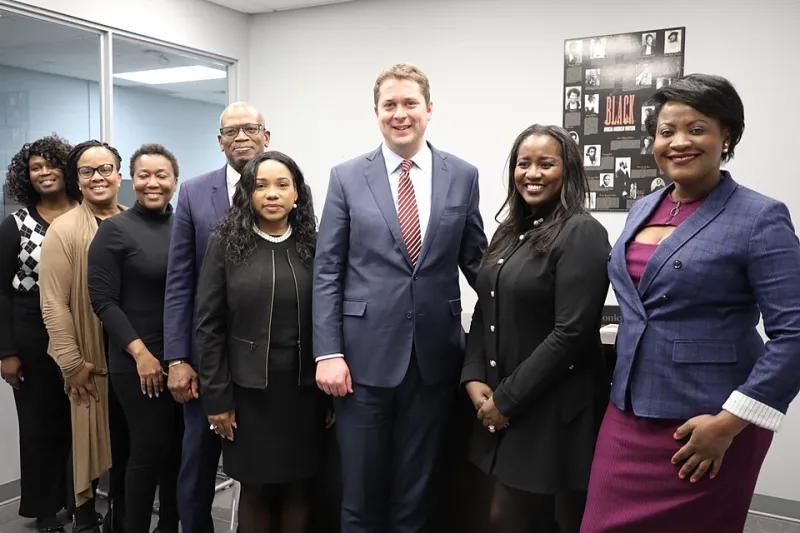
Photo: Andre Forget Andrew Scheer, CC0, via Wikimedia Commons
There's a conversation happening right now in a golf club somewhere, over a dinner you weren't invited to, about a deal that could change someone's business trajectory. The person at the table didn't get there because they had the best pitch deck or the most impressive revenue numbers. They got there because someone vouched for them. Because they were already in the room.
For Black business owners across the country, that room has historically been locked. Not because of a lack of talent, vision, or hustle — but because access to mentorship, sponsorship, and board-level guidance has always flowed through networks that weren't built with us in mind.
But here's what's changing: Black entrepreneurs are done knocking on that door. They're building their own rooms.
The Mentorship Gap Is Real — And Expensive
Let's call it what it is. The mentorship gap isn't just an inconvenience — it's a wealth gap. Research from the Kauffman Foundation has consistently shown that access to strong mentorship and peer networks is one of the most reliable predictors of business survival and growth. When those networks are inaccessible or unwelcoming, the cost is measured in businesses that plateau too early, founders who make avoidable mistakes, and opportunities that quietly pass by.
Black entrepreneurs are statistically less likely to have access to a mentor who's been in their shoes — someone who's navigated a bank that keeps moving the goalposts, managed a supplier relationship that suddenly went cold, or figured out how to scale without the safety net of family wealth. That experiential knowledge? It's priceless. And for too long, it's been unevenly distributed.
The traditional pathway — find a mentor through your MBA program, your corporate job, your industry association — assumes a kind of institutional access that many Black founders simply haven't had. And waiting around for a corporate diversity initiative to assign you an advisor isn't a strategy. It's a delay.
What a Real Advisory Board Actually Looks Like
Here's a reframe that a lot of Black entrepreneurs have found liberating: an advisory board doesn't have to be formal, expensive, or full of people with fancy titles. What it does need to be is intentional.
Think about the five or six people whose opinions would genuinely move the needle for your business. Maybe that's someone who's already built in your industry. Maybe it's a financial strategist who understands the specific funding landscape for Black-owned businesses. Maybe it's a peer who's a few years ahead of you on the same path. That's your board. You don't need a boardroom to make it official.
Keisha Mabry, a St. Louis-based entrepreneur and author, has spoken publicly about assembling what she calls her "dream team" — a small group of advisors she approached directly, with a clear ask and a defined relationship. No corporate intermediary, no formal program. Just a genuine ask: I respect what you've built. Can we connect regularly? That directness, she's said, opened more doors than any program ever did.
The Rise of Peer Mastermind Groups
One of the most powerful trends in the Black business community right now is the rise of peer mastermind groups — small, curated circles of entrepreneurs who meet consistently to share challenges, celebrate wins, and hold each other accountable.
Unlike traditional mentorship, which is often hierarchical (someone with more experience guiding someone with less), a mastermind operates on the principle that everyone in the room has something to teach. A founder running a $500K service business might have insights that are genuinely useful to someone building a $5M product company — and vice versa.
Groups like the Black Founders Exchange and local chapters of organizations such as the National Black MBA Association and the US Black Chambers have become incubators for exactly this kind of peer-to-peer advisory culture. Members aren't waiting for permission to share what they know. They're creating the infrastructure themselves.
A Framework You Can Use Right Now
Ready to build your advisory circle? Here's a practical starting point:
Step 1: Audit your current gaps. Where does your business need the most guidance right now? Finance? Operations? Sales? Marketing? Be specific. You're not looking for a general cheerleader — you're looking for targeted expertise.
Step 2: Map who you already know. Before you reach out to strangers, look at your existing network. Who in your orbit has navigated something similar? Who do you respect and actually learn from in conversation? Start there.
Step 3: Make a direct, specific ask. Vague asks get vague responses. Instead of "Would you be my mentor?" try "I'm building an advisory circle for my business and I'd love your perspective on [specific challenge]. Would you be open to a 30-minute call once a quarter?" That's manageable for them. And it signals that you value their time.
Step 4: Create a structure. Even informal advisory relationships benefit from rhythm. Set a cadence — monthly, quarterly — and come prepared with an agenda. Show up ready to share updates, ask specific questions, and receive feedback with openness. The more prepared you are, the more your advisors will invest in you.
Step 5: Give back as you grow. The best advisory networks are reciprocal. As your business evolves, look for ways to offer value to your advisors — whether that's introductions, insights from your own experience, or simply showing up for their work the way they show up for yours.
Platforms That Are Closing the Gap
Beyond individual relationships, a new ecosystem of platforms and programs is actively working to democratize mentorship for Black entrepreneurs. BlackBizList is itself part of that ecosystem — a place where connections that might never happen organically can start with a search and a click.
Programs like SCORE's mentorship matching, Goldman Sachs' One Million Black Women initiative, and Accion Opportunity Fund's business advising services are also creating more structured pathways. The key is not waiting to stumble onto these resources — it's actively seeking them out and stacking them strategically.
The Bigger Picture
Building your own advisory board is more than a business tactic. It's a declaration that you're not going to let the absence of a traditional pipeline determine the ceiling of your ambition. Every Black entrepreneur who builds a strong advisory circle and then turns around to mentor someone else is doing something structural — they're creating the network that should have always existed.
The mentorship gap is real. But so is the community that's closing it — one intentional relationship at a time.